

A comparison of reporting concordance between Cambridge University Hospitals and Charing Cross Gestational Trophoblastic Disease Service for Gestational Trophoblastic Disease.

A rare case of borderline Brenner tumour of ovary in a young woman.

A case of highly aggressive large cell neuroendocrine carcinoma of cervix.
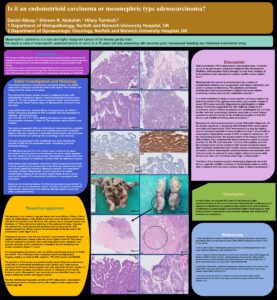
Mesonephric carcinoma is a rare and highly malignant tumour of the female genital tract. We report a case of mesonephric adenocarcinoma of cervix in a 76 years old lady presenting with recurrent PMB and thickened endometrial lining.

This poster showcases the results of an audit on testing of endometrial cancer for Lynch syndrome according to stepwise testing guidance by NICE. The primary finding was variability in testing between serous and non-serous carcinomas for MMR deficiency.
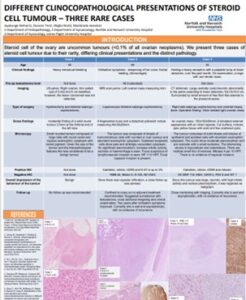
We present three cases of steroid cell tumour with three different clinical presentations and a wide range of differing morphological features. These three cases range from benign to frankly malignant with only one showing the typical clinical presentation of virilisation. We want to emphasize that steroid cell tumours show uncertain malignant behaviour and are difficult to diagnose, especially if virilising symptoms are absent. We also want to highlight that careful immunohistopathological analysis of the submitted specimens can be extremely useful in arriving at a definite diagnosis.
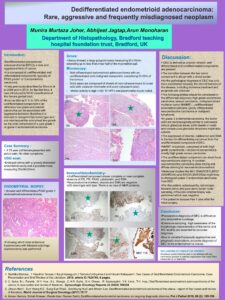
75/ F, on endometrial biopsy showed well differentiated endometrioid adenocarcinoma. Later TAH, showed dedifferentiated endometrioid adenocarcinoma. Emphasizing that extensive sampling , awareness and IHC are key features for accurate diagnosis of this tumour.

This is the first reported example of a sclerosing variant of liposarcoma in the ovary. These tumours are characterised by a rapid and aggressive clinical course.
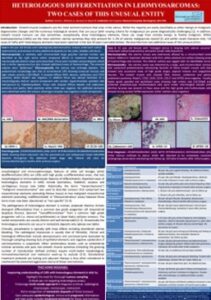
Hard as bone and flexing muscles, these are unusual tumours to find in the uterus.

Poster 9: NTRK-associated Spindle Cell Neoplasms
Don’t lose “track” of these NTRK tumours. Their site and morphology varies but this “magic bullet” therapy helps keep them in line.
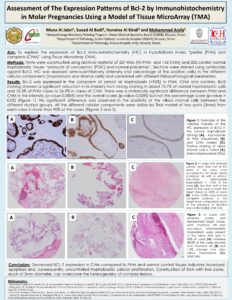
Bcl-2 immunohistochemistry, using TMA, was explored in molar pregnancies. We found decreased expression in CHM compared to PHM and normal trophoblastic tissues. This might indicate increased cell apoptosis. Construction of TMA with two cores, each of 3mm diameter, can overcome tissue heterogeneity of complex lesion.
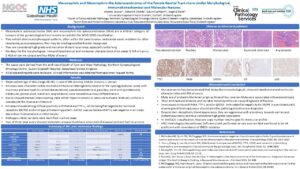
Mesonephric adenocarcinoma (MA) and mesonephric-like adenocarcinomas (MLA) are a recently described, distinct category of tumours of the gynaecological tract. They often exhibit diverse morphological patterns, often within the same tumour, and can be easily mistaken for other neoplasms. As a consequence, they may be misdiagnosed and under-recognized. The authors report six cases of MA/MLA of the gynaecologic tract (1 uterus, 4 ovary, 1 cervix) and describe in detail their morphological, immunohistochemical and molecular characteristics.
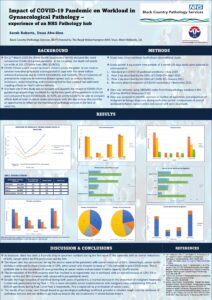
A review of the impact of Covid-19 on gynaecological pathology workload – comparing pre-pandemic, lockdowns, and Covid-recovery period.

An interesting case of mixed endometrioid adenocarcinoma and mullerian adenosarcoma of the uterus.

Hydatidiform molar pregnancies have more favourable outcomes when there is effective and timely communication between local hospitals and Centres for Trophoblastic Disease (CTD). Our QIP reviews ways to make our referral pathways more robust following formation of a new pathology hub.
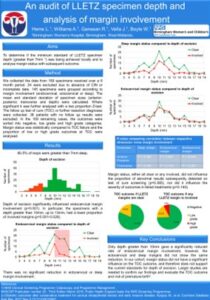
Do margins matter? An UK based audit on depth of cervical LLETZ specimen and clearance of insitu disease.

Here we present a very interesting and rare case of highly-differentiated follicular carcinoma of ovarian origin with omental metastasis, in a patient presenting with breathlessness and Meigs’s syndrome. we also discuss the literature on this recently described entity.
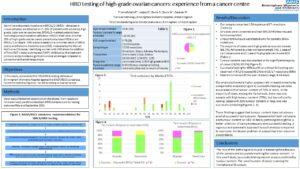
In this study, we audited the HRD/tBRCA testing pathway at Birmingham Women’s Hospital against the BAGP/BGCS consensus recommendations (figure 1) for BRCA testing in ovarian cancer.
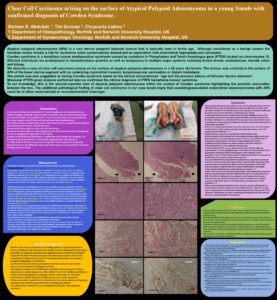
Atypical polypoid adenomyoma (APA) is a rare uterine polypoid biphasic tumour that is typically seen in fertile age. Although considered as a benign tumour the literature review reveals a risk for recurrence when conservatively treated and an association with endometrial hyperplasia and carcinoma.

A case report on genitourinary malignancies in a background of Schistosomiasis. A lady with a history of immigration to the UK and positive Schistosoma serology, developed cervical and bladder malignancies and showed calcified Schistosoma eggs on the biopsies!

The aim of the audit is to compare the whole of the MMR pathway at Birmingham Women’s Hospital with the recommendation on the BAGP guidance document and NICE diagnostic guidance DG42.

Clinicians should be aware that congenital uterine malformations and uterine malignancies can coincide. Uterine malformations may cause false negative results upon initial histopathological examination if only one horn is affected. In these cases – clinical, radiological and histopathological correlation is key.
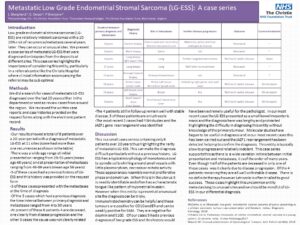
Metastatic Low Grade Endometrial Stromal Sarcoma: a small case series highlighting this rare entity at unusual sites.

(For exhibition only)
The practice of reviewing histology in patients diagnosed with cancers is based on the premise that it improves the quality of healthcare and helps avoid diagnostic errors. However, it results in a large amount of extra work for pathologists with an increase in administrative work and healthcare costs and potential delay in diagnosis. This is on the background of chronic pathology understaffing with only 3% of pathology departments in UK having enough staff to meet clinical needs. The BAGP and BGCS aim to provide evidence-based guidance for pathology reviews. The first step was to undertake a survey of current practice including volume of work generated by reviews, clinical indications, impact on clinical management and whether evidence or protocol based. A multidisciplinary group from both societies including pathologists, surgeons, and oncologists formulated a questionnaire constituting 26 questions. The survey was sent by email to the membership of both societies.

Superficial endometrial spread of cervical carcinoma is an unusual entity. This pattern of invasion has unknown prognostic significance due to its rare incidence and does not currently impact FIGO staging. We present 2 interesting cases demonstrating this pattern of spread and discuss their diagnostic workup.

A series of six rare cases of aggressive angiomyxoma of vulva with a mean age of 36 years. Two cases were recurrent. Microscopically, classical morphology was seen. ER, PR and smooth muscle markers were positive in nearly all of the cases. Due to its rarity and a high rate of recurrence, one should keep this entity in mind while dealing with such vulval masses.

We report an unexpected case of ovarian actinomycosis on intraoperative frozen section in a patient presenting with a tuboovarian mass. Ovarian actinomycosis poses diagnostic challenges by mimicking malignancy, thus frozen section plays a key role in avoiding unnecessary surgery.

The aim of the study was to determine how many cases of EMPD had been diagnosed at our centre in the past decade and to find out which IHC markers were used. Our second aim was to develop a small panel of IHC that would aid diagnosis.
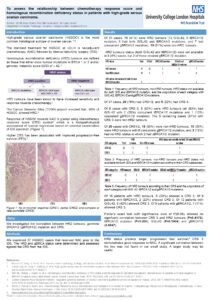
We assessed the relationship between chemotherapy response score and homologous deficiency status in patients with high-grade serous ovarian carcinoma. In our small study no correlation was identified but a larger study may be useful.
A comparison of reporting concordance between Cambridge University Hospitals and Charing Cross Gestational Trophoblastic Disease Service for Gestational Trophoblastic Disease.
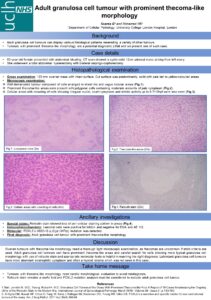
- Adult granulosa cell tumours can display various histological patterns.
- Prominent thecoma-like morphology is a potential diagnostic pitfall.
- Careful morphological evaluation, Reticulin stain and testing for FOXL2 mutation analysis are the key to diagnosis.
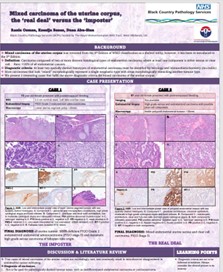
Two very interesting cases of ‘mixed’ carcinoma of the uterine corpus. Can you guess which is the imposter?

An audit on quality of reporting, MMR testing and concordance between pre-operative and post-operative final histological diagnosis of endometrial carcinomas.

An audit of block taking in omentectomies from ovarian cancer resection specimens against RCPATH dataset guidelines.
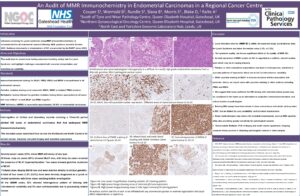
This audit aims to assess local testing outcomes including pickup rate for Lynch Syndrome and highlight challenges associated with accurate interpretation and interobserver variability.
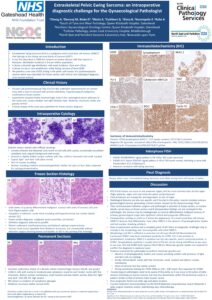
Extraskeletal Pelvic Ewing Sarcoma: an intraoperative diagnostic challenge for the Gynaecological Pathologist.
Advanced Epithelial Ovarian Cancer: An audit of Homologous Recombination Deficiency (HRD) testing with strategies for reducing test failure rate.