
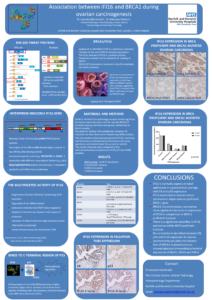
This projects aims to elucidate an association between Interferon-inducible IFI16 gene and BRCA1 gene in BRCA proficient and BRCA1/2 mutated ovarian carcinomas. Our preliminary data are supportive of hypothesis that IFI16 expression is dependent on proficient BRCA1 gene
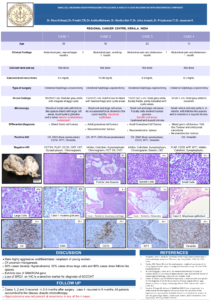
SCCOHT- rare, very aggressive cancer of young women. Is it really so rare or is it because we don’t recognize it? Here are 4 cases with peculiar features. Let’s look at the faces of this monster.
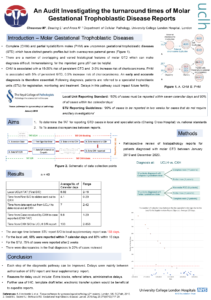
Complete and partial hydatidiform moles are uncommon gestational trophoblastic diseases (GTD) that require an accurate and timely diagnosis to reduce the risk of developing persistent GTD and choriocarcinoma. Following local diagnosis, patients are referred to specialist trophoblastic units (STU) for registration, monitoring and treatment of the disease. Delays in this pathway could impact future fertility.
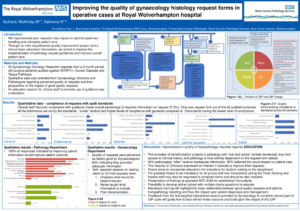
At the interface between histopathology and clinical medicine, pathology request forms play a vital role in multidisciplinary team communication. We hypothesised poor requests will impact on the processing of samples and ultimately patient care. By completing an inter-departmental quality improvement project and a clinical team education intervention, we aimed to improve the implementation of pathology request guidelines and improve overall patient care.
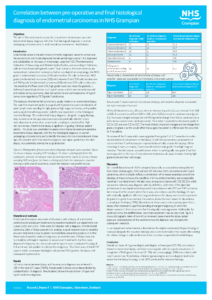
This study assessed our department’s concordance between pre-operative and final histological diagnosis in endometrial carcinomas over a 2 year period. We showed 79% concordance overall and 100% concordance for type II carcinomas.

This study identifies that 53% of our endometrial carcinomas in our Health Board have high risk features (high grade, high stage, or extensive lymphovascular space invasion) and this group would therefore most benefit from somatic POLE mutation testing.
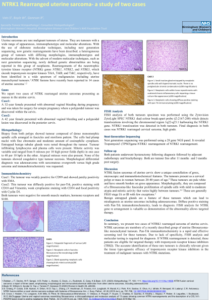
We present two cases of NTRK1 rearranged sarcoma of uterine cervix. These are members of a recently described group of uterine fibrosarcoma-like mesenchymal tumours. These patients are eligible for targeted therapy with tropomyosin receptor kinase inhibitors.
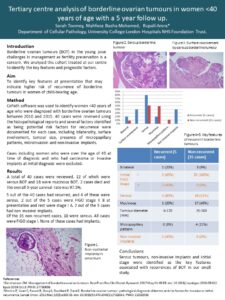
Borderline ovarian tumours (BOT) in the young pose challenges in management as fertility preservation is a concern. We analysed this cohort treated at our centre to identify the key features and prognostic factors.
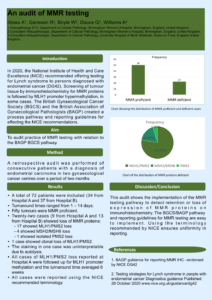
In 2020, the National Institute of Health and Care Excellence (NICE) recommended offering testing for Lynch syndrome to persons diagnosed with endometrial cancer (DG42). The British Gynaecological Cancer Society (BGCS) and the British Association of Gynaecological Pathologists (BAGP) created a pathway and reporting guidelines for effecting the NICE recommendations.

Following a successful pilot scheme for BMS reporting in 2012, the IBMS and RCPath have jointly defined the role of biomedical scientists (BMS) in histopathology reporting . We present an audit of the concordance and reporting experience of a RCPath/IBMS Stage A Gynaecological pathology trainee.
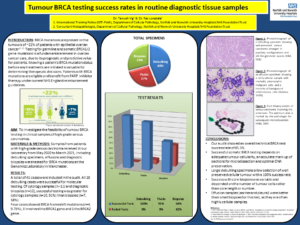
Tumour BRCA testing success rates in routine diagnostic tissue samples – Audit from Norfolk & Norwich University Hospital. Our audit had an overall technical BRCA test success rate of 85.3%. Debulking specimens and effusion samples are superior to small biopsies for this test

A case report of Mesonephric-like adenocarcinoma of the ovary arising within an endometriotic cyst with associated mucinous borderline tumour. Follow up shows aggressive behaviour with multiple sites of recurrence within 18 months.
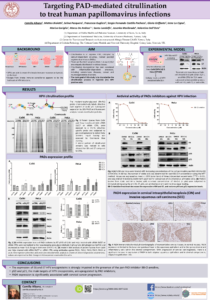
We exploited citrullination as new targetable PTM to treat HPV infections. Our findings revealed that inhibition of PAD-mediated citrullination impairs E6 and E7 expression and restores p53 and p21 levels. Moreover PAD4 expression is correlated to cervical cancer progression.

NNUH audit of BNC endocervical cells confirms the rarity of this report and significant risk of high grade outcome. Significant inter observer variation exists. Audit, reviewing own cases, training & use of strict criteria reduces misinterpretation.
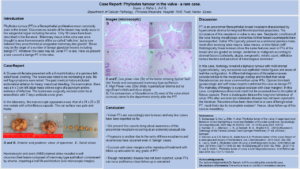
Poster 15: Phyllodes tumour: A rare case in the vulva.
Phyllodes tumour (PT) is a fibroepithelial proliferation most commonly seen in the breast. Occurrences outside of the breast may rarely occur in the anogenital region including the vulva. Only 19 cases have been described in the literature1. Mammary tissue in the vulva was once thought to arise from remnants of the so-called ‘milk-line’, but is now believed they arise from local anogenital mammary-like glands2. These may be the origin of a number of benign glandular lesions including benign PT. Whatever the case may be, vulval PT is rare. Here we present a rare case of a benign PT in the vulva.
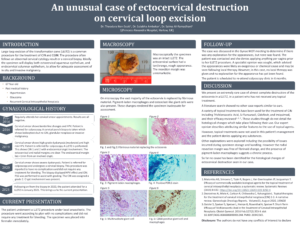
A rare case of ectocervical destruction on LLETZ, for which the cause has not been found.

Poster 17: Carcinosarcoma ovary: A report of 3 cases
Carcinosarcoma of the ovary is a rare malignant tumour of the ovary with an aggressive clinical course. It accounts for 2% of all ovarian malignancy. Herein we report 3 cases of ovarian carcinosarcoma, of which one was diagnosed with a synchronous mucinous adenocarcinoma gall bladder and another with a metachronous breast carcinoma. Because these case scenarios are rare, it necessitates mandatory genetic studies, followed by family counselling. They can also be misdiagnosed as metastasis and can hamper the treatment.
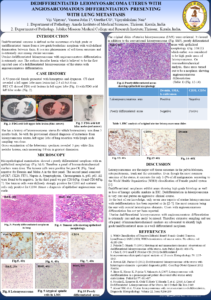
Interesting case of a patient with previous history of leiomyosarcoma uterus presenting with a poorly differentiated lung neoplasm. This is believed to be the first reported case of a dedifferentiated leiomyosarcoma of the uterus with angiosarcomatous differentiation.

Adult granulosa cell tumor is one of the uncommon sex cord Stromal tumor. It is seen to be associated with endometrial carcinoma in 5 % to 25% of cases. So, gynaecologist should have heightened clinical suspicion of their concomitant presentation in post menopausal women presenting with bleeding . This can prevent unnecessary delay in diagnosis and management of patients.
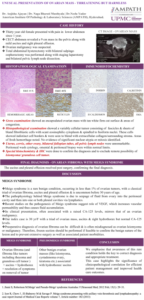
Our case illustrates the importance of clinicopathological correlation & appropriate surgery preceded by frozen section for optimal management of Meigs syndrome with resultant overall good prognosis despite alarming presentation.

Cotyledonoid dissecting leiomyoma of the uterus is an uncommon variant of benign uterine smooth muscle neoplasm. It may pose a clinical and radiologic dilemma.
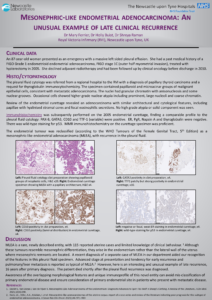
An elderly patient with a history of endometrioid endometrial adenocarcinoma presented with a pleural effusion. On review the endometrial tumour was reclassified as a new, rare entity: mesonephric-like endometrial adenocarcinoma, with recurrence in the pleural fluid.
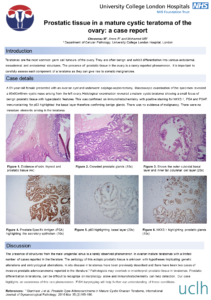
We report a rare case of a 61-year-old female who presented with an ovarian cyst and underwent salpingo-oophorectomy. Macroscopic examination of the specimen revealed a 85x90x48mm left ovarian mass which for the most part was characteristic of a mature cystic teratoma.

Malignant Brenner tumour account for less than 5% of Brenner tumours of which 12% are bilateral. They occur in women over 50 years of age. These tumours are usually large, may be solid or cystic with mural nodules. We present a rare case of Bilateral Brenner tumour in a younger patient that metastasis to the myometrium.

Mature cystic teratomas (dermoid cysts) of the ovary are very rarely associated with androgen production. The source of androgens in these cysts may be tumours such as Sertoli–Leydig cell tumour or Leydig cell hyperplasia. In this study, we present a case of virilisation in a postmenopausal female patient, where Leydig cell hyperplasia in a mature cystic teratoma was found to be responsible for the production of testosterone.

Extramammary Paget disease; a woman with a vulval lesion. Epidermis contains a population of atypical cells showing “Pagetoid” extension and positivity for basal markers: CK5/6 (weak/focal), p40 and p63. Represents an unusual basal phenotype akin to a basal-like breast carcinoma.

An audit of mismatch repair deficiency testing in endometrial cancers at St George’s University Hospitals NHS Trust – were the NICE guidelines followed? Did all patients with possible Lynch syndrome receive germline testing? Read this poster to find out more….
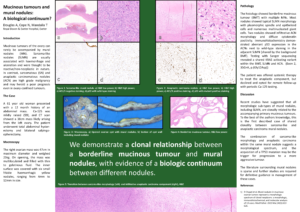
We present a case of borderline mucinous tumour and mural nodules with evidence of a clonal relationship, and a biologic and morphologic continuum between different types of mural nodules.
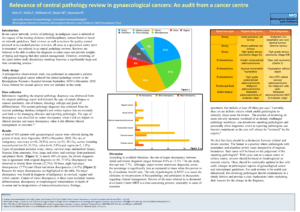
Central pathology reviews refine the diagnosis, and in some cases, alter patient management. However, reviewing all the cases before multi disciplinary meetings becomes a time consuming process. Review criteria should be continually updated.

In this study, we analyse macroscopic handling of obstetric hysterectomy specimens, with a special emphasis on Placenta Accreta Spectrum. We discuss the issues surrounding this subject and offer solutions to facilitate the process.

My journey into the world of Gynaecological pathology began 6 years ago as a Biomedical Scientist at UCLH. This innovative training pathway was created for a cohort of senior scientists to provide efficient patient care and was based on an adapted curriculum that was designed for the medical trainees.
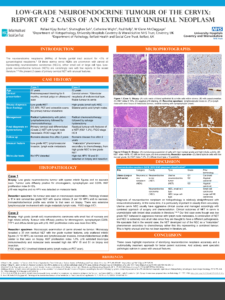
Low-grade neuroendocrine tumour of the cervix: Report of 2 cases of an extremely unusual neoplasm”. NET developing out of the NEC as a “maturation” phenomenon.
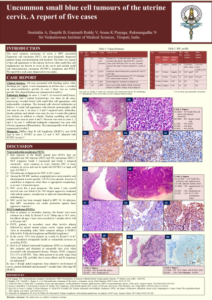
This is a report of uncommon small blue cell tumours of cervix, one case of DLBCL, non GCB type, three cases of Small cell neuroendocrine carcinoma and one case of mixed Squamous cell carcinoma and Small cell neuroendocrine carcinoma. Immunohistochemistry was done in all cases.

We present 10 cases of a previously undescribed differentiation pattern within ovarian teratomas, which we designate “bronchus-like structures. This is an example of an unusual benign lesion which should not be mistaken for a malignant process.
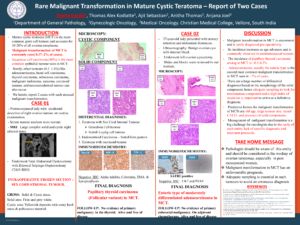
Malignant transformation of mature cystic teratoma is rare with no proper guidelines on management and carries a poor prognosis. We present 2 such cases; follicular variant of papillary thyroid carcinoma and enteric type adenocarcinoma. Pathologists should be aware of this, during workup of MCT to avoid an erroneous diagnosis.

Presenting Adenoid basal carcinoma , a rare type of non mass forming uterine cervical cancer of low metastatic potential detected incidentally in the cervix of a 79 yr old lady who underwent vaginal hysterectomy for procidentia and the differentials in morphologic diagnosis.
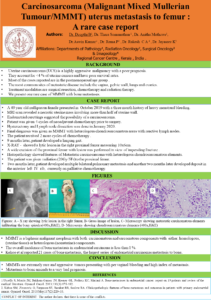
We hereby present a rare case of malignant mixed Mullerian tumour of uterus metastasis to femur. There are no cases of MMMT uterus metastatic to femur bone reported so far in literature.

An unusual presentation of borderline mucinous tumours of ovary – 2 case scenarios mimicking malignancy.